
Panorama Test Receives EU IVDR Certification – Why Do We Continue to Offer This Particular NIPT?
Dr Marek Šois
Obstetrician-gynecologist specializing in fetal medicine
The Panorama test is a targeted SNP-based screening test. I explain what we actually analyze in the maternal blood sample, why I have used this test since 2013, and where its limits lie.
Natera informed its European partners that, as of May 2026, the Panorama™ test is certified under the European Union In Vitro Diagnostic Medical Devices Regulation (IVDR, EU 2017/746). The certification covers Panorama testing performed at Natera’s laboratory and also applies in Estonia.
For the patient, this means the test’s quality, safety, and performance have been assessed under the European Union’s more stringent requirements.
The certification does not mean that the Panorama test is automatically better than every other NIPT. It does, however, give the Fetal Ultrasound Center confidence to continue its long-standing cooperation with Natera and to offer the Panorama test in the future.
I have used the Panorama test in my work since 2013. Over the years, I have become increasingly convinced that the value of a good screening test is not measured by the length of the list of conditions it covers.
What matters more is how reliably the test assesses the selected chromosomal changes, what the result means for the individual family, and whether we know the next step.
The key points in brief
-
The Panorama test uses an SNP-based method that analyses maternal and placental genetic patterns.
-
The test primarily assesses the risk of trisomies 21, 18 and 13, as well as 22q11.2 deletion syndrome.
-
The SNP-based method is particularly useful in twin pregnancies and for screening for triploidy.
-
We do not routinely offer an expanded microdeletion panel because, for a very rare condition, a high-risk result may be unreliable.
-
The Panorama test remains a screening test: it does not replace fetal ultrasound or, when indicated, chorionic villus sampling or amniocentesis.
What makes the Panorama test different?
During pregnancy, short fragments of cell-free DNA, or cfDNA, circulate in the mother’s blood plasma. Most originate from the mother and a smaller proportion from the placenta. In everyday language, the latter is often called fetal cell-free DNA, although it enters the maternal bloodstream mainly from the placenta.
Because the placenta and the fetus usually develop from the same fertilized egg, this DNA generally reflects the fetal chromosome complement. The proportion of placental DNA in the blood sample is called the fetal fraction. When the fetal fraction is very low, providing a reliable risk assessment becomes more difficult.
I want the laboratory to measure the fetal fraction and not issue a result when the available data are insufficient to provide a reliable answer. Many NIPTs primarily assess whether the maternal blood sample contains relatively more or fewer DNA fragments from a particular chromosome than expected.
The Panorama test uses a different, SNP-based method. An SNP, or single-nucleotide polymorphism, is a specific position in DNA where the genetic sequence may differ between people by a single DNA letter. An SNP is not a disease. These natural variations form a genetic pattern characteristic of each person.
The Panorama test analyses SNP patterns at selected positions in the DNA. These patterns are used to computationally distinguish the maternal and placental DNA contributions and to assess which chromosome number and genetic pattern best fit the analytical data.[1–3]
Put simply, the Panorama test does not merely count whether, for example, there are more DNA fragments from chromosome 21 than expected. It also considers how those fragments fit the genetic patterns of the mother and the placenta.
This is one of the main reasons why I have continued to use the Panorama test.
SNP-based analysis is not a diagnostic test, but it helps assess situations that are harder to recognize by looking only at the relative number of chromosome fragments.
At the Fetal Ultrasound Center, the Panorama test focuses primarily on assessing the risk of Down syndrome, Edwards syndrome, Patau syndrome, and 22q11.2 deletion syndrome, also known as DiGeorge syndrome.
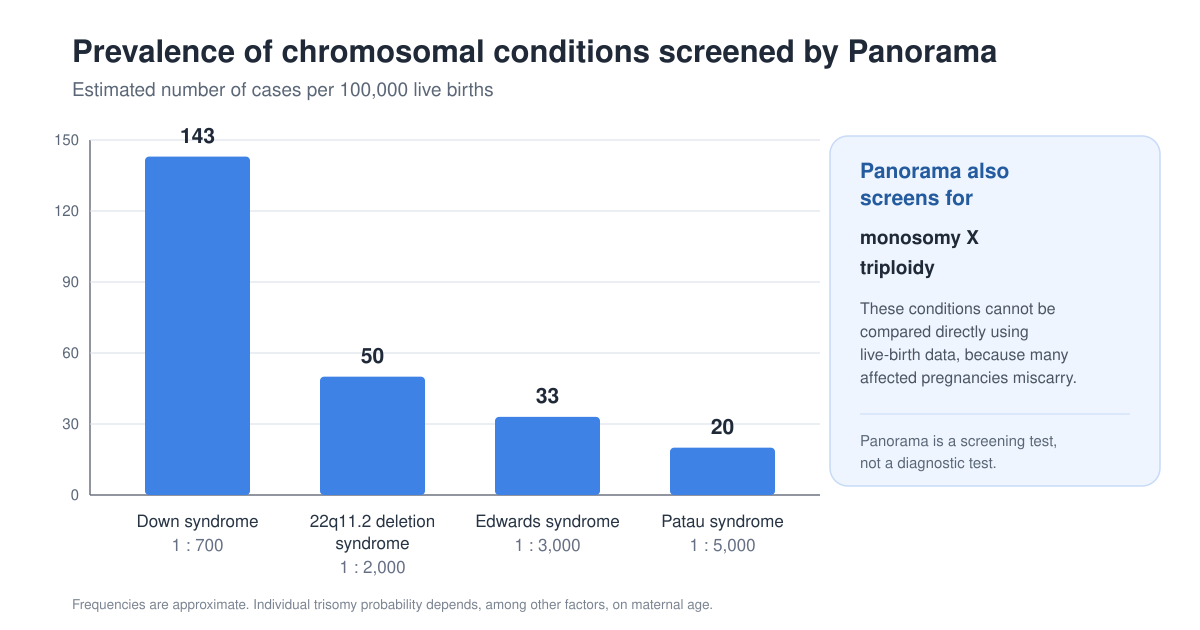
Depending on the pregnancy characteristics and the scope of the test, it may also provide information about triploidy, monosomy X or Turner syndrome, and other numerical sex chromosome abnormalities.
This is a deliberate choice. We do not try to search for as many rare conditions as possible from a single blood sample. We focus on chromosomal changes with available clinical performance data and implications we can explain honestly to the patient.
Targeted screening: why 22q11.2, but not an expanded panel?
22q11.2 deletion syndrome, or DiGeorge syndrome, is caused by the loss of a small region of DNA on chromosome 22.
It may be associated with congenital heart defects, immune system disorders, palatal abnormalities, and later difficulties with speech, learning, and development.
Unlike Down syndrome, the risk of 22q11.2 deletion syndrome is not associated with maternal age in the same way. It may therefore occur in the fetus of either a younger or an older pregnant woman.
The large prospective international SMART study evaluated the Panorama test’s screening performance for 22q11.2 deletion syndrome.
The study included 20,887 pregnant women across 21 centers in six countries, and it obtained genetic outcomes for 18,289 pregnancies.[4]
The test’s enhanced algorithm was evaluated without knowledge of the actual genetic outcome. It detected 10 of the 12 confirmed cases, including smaller-than-typical deletions.
Sensitivity was 83.3%, specificity was greater than 99.9%, and the positive predictive value, or PPV, was 52.6%.
For the patient, a PPV of 52.6% means diagnostic testing confirmed the 22q11.2 deletion in about half of pregnancies with a high-risk result. In approximately half, it was not confirmed.
It is important to me that I can explain not only what the test looks for, but also how often a high-risk result is confirmed.
A low-risk result does not completely exclude the syndrome, and a high-risk result is not a diagnosis.
The same principle explains why we do not offer an expanded microdeletion panel.
A long list of conditions may create the impression that the test provides a more comprehensive and certain overview of fetal health. With rare conditions, however, the result may be harder to interpret.
The rarer the condition being screened for, the more difficult it is to achieve a high positive predictive value.
In data published by Natera, the PPV for some microdeletion syndromes included in the expanded panel is approximately 2–17%. A PPV of 5%, for example, means that about five out of 100 high-risk results would be confirmed by diagnostic testing.[5]
For the remaining families, such a result may lead to considerable anxiety, additional consultations and an invasive diagnostic procedure, even though the suspected condition is not actually present in the fetus.
NIPT may also fail to detect all the mechanisms that can cause the same syndrome.
For example, Prader–Willi syndrome and Angelman syndrome may be caused not only by a deletion, but also by uniparental disomy or a methylation disorder. Screening for a deletion therefore does not exclude the syndrome as a whole.
Rare conditions are not less important. The question is whether we have a sufficiently reliable method to screen for them.
If an ultrasound raises a suspicion of a specific disorder, it is often more appropriate to perform a diagnostic test than to add another screening test with an uncertain meaning.
When is the SNP-based method particularly useful?
In twin pregnancies, I choose the Panorama test first.
Non-identical twins are genetically different, and the fetal fraction of each twin may also differ. If only the combined amount of DNA fragments from both fetuses is assessed, the stronger signal from one fetus may mask the lower fetal fraction of the other.
The SNP-based method can assess whether the twins are identical or non-identical.
In non-identical twin pregnancies, it can distinguish each fetus's genetic contribution and assess each twin's fetal fraction separately. Depending on the scope of the test, the Panorama test may also provide information about the sex of each fetus and their individual risk of trisomies 21, 18 and 13.[6,7]
Another important feature is assessing the risk of triploidy. In triploidy, the fetus has 69 chromosomes instead of the usual 46—an entire additional chromosome set.
Because triploidy increases the amount of DNA from all chromosomes at the same time, a method based only on relative chromosome counts may miss the change. From the SNP pattern, the Panorama test may identify a situation in which three chromosome sets best fit the analytical data.[8]
The Panorama test may also assess the risk of monosomy X, or Turner syndrome, and other numerical sex chromosome abnormalities.
Screening for these conditions is less accurate than screening for trisomy 21. The result may be affected by placental mosaicism, the mother’s own sex chromosome variation and other biological factors. A high-risk result therefore requires counseling and diagnostic confirmation.[9]
The Panorama test may also provide important information to younger pregnant women.
Their baseline risk of Down, Edwards and Patau syndromes is generally lower, but triploidy, sex chromosome abnormalities and 22q11.2 deletion syndrome are not related to maternal age in the same way. An important distinction must nevertheless be made: a test’s analytical performance and the probability that a high-risk result will be confirmed are not the same. Positive predictive value also depends on the condition's prior risk.
The placental DNA fraction is another important consideration. A low fetal fraction may occur early in pregnancy and is more common in women with a higher body mass index. This may increase the likelihood that NIPT will not provide a result from the first blood sample.
On 26 May 2026, Natera announced that the Panorama test had been enhanced with SNP-informed deep sequencing technology, or SNP-iDS. Approximately 97–98% of samples proceed through the standard SNP workflow.
Approximately 2–3% of samples with a low fetal fraction or an atypical signal are referred for additional deep sequencing. This provides more analytical information from selected DNA regions.[10]
Natera’s published prospective, blinded validation study included 3,323 pregnant women. Of these, 242 samples had a low placental DNA fraction or did not receive a result with the previous analysis.
With the new workflow, selected cases could receive a result at a fetal fraction as low as 1%, and 0.5% of samples received no result—about 1 in 200 tests.
The study confirmed the reference outcomes with diagnostic genetic testing.
This does not mean every sample with a 1% fetal fraction will yield a result, or that a low fetal fraction has lost its clinical significance. The new workflow may, however, reduce the need for repeat sampling, particularly in women with a higher body mass index, in whom the proportion of placental DNA in the blood is more often low.
If no result is obtained, we assess this together with the gestational age, ultrasound findings and the patient’s clinical background.
What can the Panorama test not detect?
The Panorama test is not a whole-genome test of the fetus. It does not answer questions about every chromosomal or genetic disorder, does not assess fetal organ structure, and does not exclude most congenital anomalies. A low-risk result therefore cannot guarantee a healthy birth.
Two measures are particularly important for understanding test performance:
-
Sensitivity, or detection rate, indicates the proportion of pregnancies affected by the chromosomal change under investigation that the test identifies as high risk.
-
Positive predictive value, or PPV, indicates the proportion of pregnancies with a high-risk result in which diagnostic testing confirms the condition.
PPV is not the same for every patient. It depends on the prevalence of the condition, maternal age, ultrasound findings, and the pregnancy’s prior risk. A laboratory’s overall PPV is therefore not automatically the individual probability for a particular patient.
The Panorama test is a screening test. A low-risk result reduces the probability of the condition being screened for, but does not exclude it completely. A high-risk result indicates an increased probability, not a confirmed diagnosis. A definitive answer requires diagnostic testing.
How do we choose the right test for a particular pregnancy?
Before taking the NIPT blood sample, we perform a Pre-NIPT ultrasound. We check that the pregnancy is progressing, confirm the gestational age and number of fetuses, and assess the fetal structures visible at that stage.
The ultrasound may reveal that the appropriate next step is not NIPT, but a diagnostic test. If the fetus has increased nuchal translucency or a suspected structural anomaly, the range of possible causes may be much broader than the chromosomal changes assessed by the Panorama test.
The Panorama test, the OSCAR test, and diagnostic testing answer three different questions:
-
Panorama test: is the fetus at increased risk of one of the chromosomal changes assessed by the test?
-
OSCAR test: are the fetus’s early development and visible organ structures appropriate for the gestational age, and are there ultrasound signs of a structural anomaly or chromosomal disorder?
-
Chorionic villus sampling or amniocentesis: does the suspected chromosomal or genetic disorder actually affect the fetus?
These examinations do not compete with or replace one another. Each answers a different clinical question.
At the Fetal Ultrasound Center, we offer both the Panorama test and the KaryoPlus test because not every family is seeking the same information.
The Panorama test is a targeted SNP-based screening test. Its distinguishing features include extensive validation for selected chromosomal changes, assessment of the risk of triploidy and a more individualized approach to twin pregnancies.
The KaryoPlus test offers broader genome-wide chromosomal screening. Families may consider it if, in addition to common trisomies, they want screening information about numerical changes in other chromosomes and larger gains or losses of chromosomal material.
A broader test may produce more findings, but some are rare, and their significance may remain uncertain. Therefore, no single test suits everyone equally. My role is to help each family understand what each test may reveal and which questions will remain unanswered even after testing.
As a fetal medicine specialist, my aim is not to offer every woman as many tests as possible. I want to help her choose the examination that answers the right question for that particular pregnancy.
A good prenatal testing pathway doesn't begin with choosing the longest list of conditions. It begins with ultrasound and honest counseling—with an understanding of what each result will actually mean for that family.
Patient questions and answers
-
What does IVDR certification mean for the patient?
The IVDR certificate provides additional assurance to the patient that the quality, safety, and performance of the Panorama test have been assessed according to the stricter requirements of the European Union.
The manufacturer must demonstrate the test's performance, follow a verified quality system, and monitor the test's reliability even after its introduction.
This means better quality control, traceability of results and the assurance that the Panorama test can continue to be offered in Estonia.
The IVDR certificate does not make the test infallible or a diagnostic test, but confirms that its use and performance monitoring comply with current European Union requirements.
-
Does a low-risk Panorama result mean that the baby is definitely healthy?
No. Low risk significantly reduces the likelihood of the chromosomal disorders the test examines, but it does not exclude all chromosomal and gene disorders or structural fetal abnormalities.
Therefore, ultrasound examinations are necessary even after a low-risk Panorama result. -
Is the Panorama test necessary after a normal PGT-A result?
Usually not. If a high-quality PGT-A test has assessed the transferred embryo as euploid, the Panorama test usually provides little additional information about the most common trisomies.
The Panorama test is not a confirmatory test for PGT-A, as both tests mainly assess genetic material originating from the placenta.
Before deciding, we review the scope of the PGT-A test, the assessment of mosaicism, and the ultrasound findings. If the family wants diagnostic certainty, discuss amniocentesis. Ultrasound examinations remain necessary regardless of the PGT-A result.
-
When is screening no longer sufficient?
If an ultrasound examination raises a suspicion of a fetal anomaly, the nuchal translucency is increased, or screening indicates a very high risk of a chromosomal condition, another screening test may not provide the answer the family needs.
In such cases, we discuss chorionic villus sampling or amniocentesis. We select the laboratory analysis for the diagnostic sample based on the ultrasound findings and the specific clinical question.
References
- Pergament E, Cuckle H, Zimmermann B, et al. Single-nucleotide polymorphism-based noninvasive prenatal screening in a high-risk and low-risk cohort. Obstet Gynecol. 2014;124(2 Pt 1):210–218.
- Nicolaides KH, Syngelaki A, Gil M, Atanasova V, Markova D. Validation of targeted sequencing of single-nucleotide polymorphisms for non-invasive prenatal detection of aneuploidy of chromosomes 13, 18, 21, X, and Y. Prenat Diagn. 2013;33(6):575–579.
- Dar P, Jacobsson B, Clifton R, et al. Cell-free DNA screening for prenatal detection of aneuploidy: a prospective study. Am J Obstet Gynecol. 2022;227(2):259.e1–259.e14.
- Dar P, Jacobsson B, Clifton R, et al. Cell-free DNA screening for prenatal detection of 22q11.2 deletion syndrome. Am J Obstet Gynecol. 2022;227(1):79.e1–79.e11.
- Natera, Inc. Panorama™ prenatal screen: test specifications and clinical performance. Available from: https://www.natera.com/womens-health/panorama-nipt-prenatal-screening/patients/
- Norwitz ER, McNeill G, Kalyan A, et al. Validation of a single-nucleotide polymorphism-based non-invasive prenatal test in twin gestations: determination of zygosity, individual fetal sex, and fetal aneuploidy. J Clin Med. 2019;8(7):937.
- Kantor V, DiNonno W, Howard K, et al. Positive predictive value of a single nucleotide polymorphism-based NIPT for aneuploidy in twins: experience from clinical practice. Prenat Diagn. 2022;42(13):1587–1594.
- Kantor V, et al. Non-invasive prenatal screening for triploidy using single-nucleotide polymorphism-based testing. Prenat Diagn. 2022;42(8):994–999.
- Martin K, et al. Clinical performance of single-nucleotide polymorphism-based prenatal cell-free DNA screening for sex chromosome aneuploidies. Genet Med. 2023;25(8):100879.
- Natera, Inc. Natera to launch enhanced Panorama™ NIPT, powered by novel SNP-informed deep sequencing technology. May 26, 2026. Available from: https://www.natera.com/company/news/natera-to-launch-enhanced-panorama-nipt-powered-by-novel-snp-informed-deep-sequencing-technology/