
Fetal Ultrasound Centre now offers CMV screening during pregnancy.

Fetal Ultrasound Center offers pregnant women voluntary CMV risk assessment and screening in early pregnancy. CMV, or cytomegalovirus, is one of the most common congenital viral infections, yet it is still discussed relatively little during pregnancy in Estonia.
This is not a national screening program in Estonia, but rather an informed, voluntary opportunity to assess the potential risk of a recent CMV infection in early pregnancy.
For us, CMV screening is not just a blood test. It is part of an integrated fetal medicine care pathway. If a recent primary infection is detected early, the woman can be offered counseling, treatment when indicated, amniotic fluid testing, detailed fetal brain ultrasound, and targeted follow-up during the pregnancy.
Why is CMV important during pregnancy?
CMV belongs to the herpesvirus family. In adults, the infection is often mild or completely unnoticed. It may cause tiredness, sore throat, mild fever, muscle aches, or swollen lymph nodes, but in many cases, there are no clear symptoms.
For the fetus, the timing of maternal infection is especially important. The highest risk of fetal injury occurs when a primary CMV infection develops shortly before conception or during the first trimester, when the fetal organs and nervous system are developing.
Congenital CMV may cause hearing loss, visual impairment, brain developmental abnormalities, microcephaly, epilepsy, developmental delay, or severe illness in the newborn. At the same time, it is important to emphasize that not all infected fetuses develop injury. Most children with congenital CMV infection are born without symptoms, but some may later develop hearing loss or neurodevelopmental problems.
Internationally, congenital CMV is estimated to occur in approximately 1 in 200 newborns. About 1 in 5 children with congenital CMV infection may develop a birth defect or a long-term health problem, such as hearing loss.
How can the risk of CMV be reduced during pregnancy?
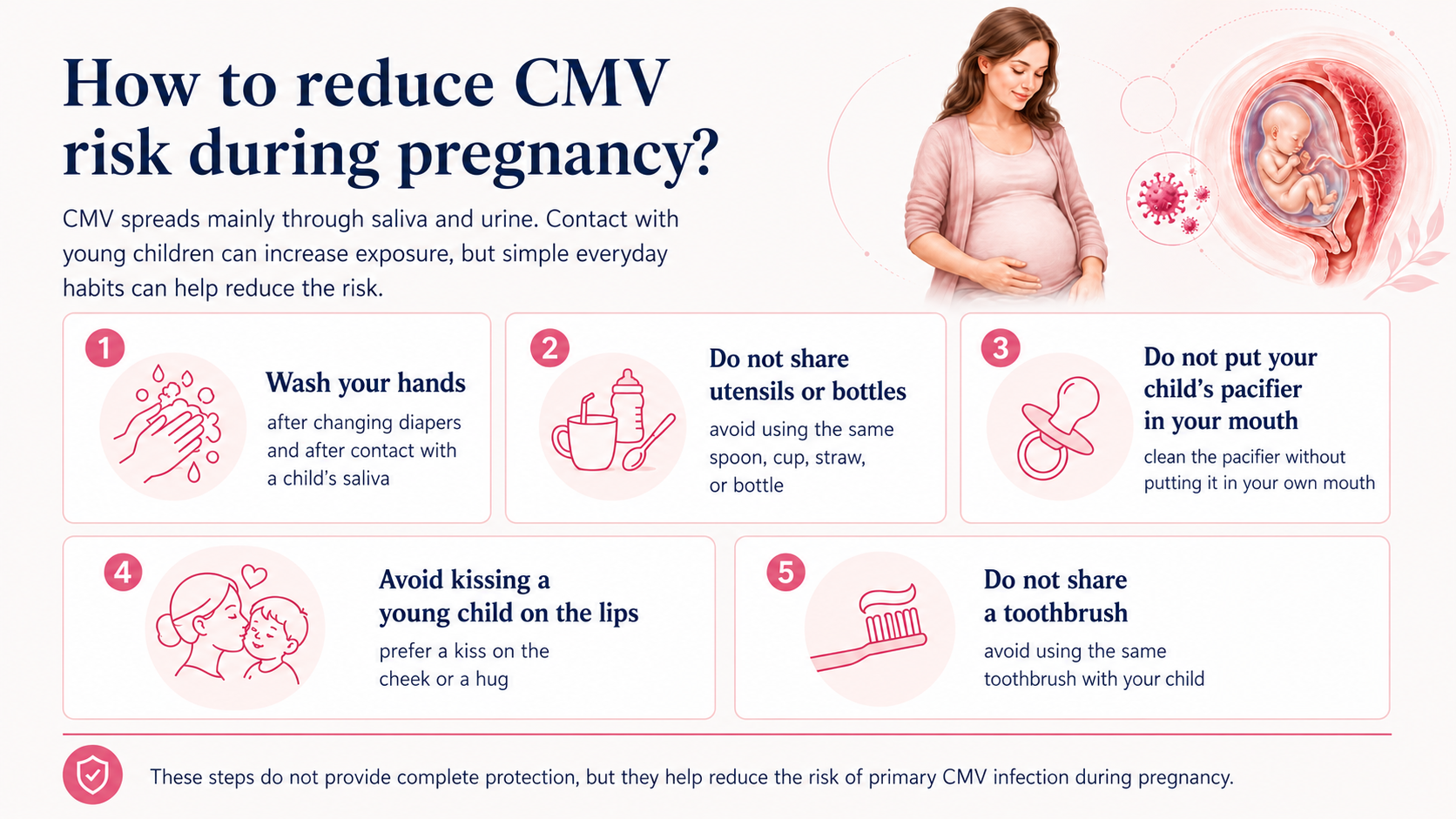
CMV spreads through body fluids, especially saliva and urine. For pregnant women, one important source of infection is often a young child, because children may shed the virus for a long time.
The risk can be reduced by washing hands after changing nappies or after contact with a child’s saliva. It is also recommended not to share a spoon, cup, drinking bottle or toothbrush with a young child, not to put a child’s pacifier into your own mouth, and to avoid kissing a young child on the lips. A kiss on the cheek or a hug is a safer option.
These simple hygiene measures do not provide complete protection, but they may reduce the risk of primary CMV infection during pregnancy.
Why perform CMV screening in early pregnancy?
With CMV, timing is crucial. The earlier a woman with a possible recent primary CMV infection is identified, the earlier it is possible to offer counseling, consider treatment, plan amniotic fluid testing, and monitor the fetal brain and growth at the right time.
The main aim of screening is to detect a possible recent primary CMV infection in early pregnancy. This is the situation in which the risk of fetal injury is most significant and early action may offer the greatest benefit.
Screening also helps determine whether the woman is susceptible to CMV, meaning that she has not previously been exposed to the virus. In that case, more specific hygiene advice can be given and, if needed, repeat testing can be offered in the second trimester.
At the same time, it is important to state clearly that standard CMV serological screening is not intended to reliably detect CMV reactivation or reinfection with a new viral strain in women with prior CMV immunity. If a woman who is CMV IgG positive develops ultrasound findings suggestive of infection during pregnancy, the situation is assessed individually regardless of the initial screening result.
CMV screening is not aimed at termination of pregnancy
It is important to emphasize that CMV screening is not a test aimed at termination of pregnancy. Early knowledge instead provides an opportunity to act at the right time: to offer counseling, consider treatment, plan diagnostics, and systematically assess fetal brain development.
The aim is to give the family greater clarity and the opportunity to make further decisions on a calmer, better-informed basis.
Ultrasound alone is not enough
Fetal ultrasound is very important in the management of CMV, but CMV risk cannot be assessed reliably on the basis of ultrasound alone. Ultrasound mainly shows consequences that have already developed, such as changes in the fetal brain, echogenic bowel, growth restriction, placental changes or changes in the amount of amniotic fluid.
Therefore, blood testing and ultrasound are not alternatives. They complement each other. The blood test helps assess the risk of a recent primary infection in the mother, while ultrasound helps assess fetal development and possible findings suggestive of infection.
When should CMV screening be performed?
Fetal Ultrasound Center recommends combining CMV screening with the early-pregnancy Fetal Double Test or the OSCAR test.
In practical terms, this means that the CMV blood test should preferably be performed at around 10–11 weeks of pregnancy, followed by a more detailed ultrasound examination after 12 completed weeks of pregnancy.
If the blood test is performed before the ultrasound examination, the woman’s CMV serostatus will be known by the time of the visit. This allows early pregnancy risks to be assessed more comprehensively and counseling to be started during the same visit if the screening result is positive or unclear.
What does CMV screening include?
The CMV screening offered at Fetal Ultrasound Center includes three tests:
- CMV IgG
- CMV IgM
- CMV IgG avidity
CMV IgG shows whether the woman has previously been exposed to CMV. CMV IgM helps assess for signs of a recent infection. CMV IgG avidity helps clarify whether the infection may have occurred recently or more likely in the past.
These tests are offered together so that the screening result can be interpreted as clearly as possible for the patient.
What does the CMV screening result mean?
- If CMV IgG and IgM are negative, this means that the woman is susceptible to CMV. In this case, Fetal Ultrasound Center provides hygiene counseling and offers repeat testing at around 16 weeks of pregnancy.
- If CMV IgG is positive and IgM is negative, this usually indicates previous exposure to CMV and makes a recent primary infection unlikely. However, prior infection does not confer absolute protection against reactivation or against infection with a new viral strain.
- If CMV IgG and IgM are both positive, CMV IgG avidity becomes important for interpreting the result. High avidity is usually a reassuring finding. Low or intermediate avidity may suggest a recent primary infection and requires prompt assessment by fetal medicine.
What happens if the screening result needs further evaluation?
If there is a suspicion of a recent primary CMV infection, the next steps are discussed with the woman. These may include antiviral treatment, monitoring maternal blood tests, planning amniotic fluid testing, and targeted assessment of fetal brain development and growth.
European studies show that in cases of primary CMV infection in early pregnancy, valaciclovir treatment may reduce the risk of transmission of the virus to the fetus. Treatment does not eliminate all risks, including the possibility of later hearing loss, but it may reduce the risk of symptomatic and severe congenital CMV infection.
Starting treatment requires counseling and monitoring of maternal health parameters, including kidney and liver function.
Amniotic fluid testing helps assess whether the virus has been transmitted to the fetus
If maternal test results suggest a primary CMV infection in early pregnancy, an amniotic fluid test or amniocentesis may be needed. CMV DNA is detected in amniotic fluid using PCR. The test helps answer an important question: has the virus been transmitted to the fetus?
Amniotic fluid testing must be timed correctly. If performed too early, the result may be falsely reassuring. Therefore, according to international recommendations, the test is usually planned after 17 weeks of pregnancy and after a sufficient time interval has passed since the maternal infection.
If CMV DNA in the amniotic fluid is negative and the test has been performed at the right time, this provides the family with considerable reassurance. If CMV DNA in the amniotic fluid is positive, it means that the fetus is infected, but this does not automatically mean a poor prognosis.
A detailed assessment of the fetal brain provides important additional information for the family
If CMV DNA in the amniotic fluid is positive or if ultrasound findings raise suspicion of fetal CMV infection, detailed assessment of the fetal brain becomes very important.
In such cases, Fetal Ultrasound Center offers a detailed fetal anomaly scan and fetal neurosonography, meaning a detailed ultrasound examination of the fetal brain. If needed, fetal brain MRI is also recommended.
A normal ultrasound examination and neurosonography are reassuring findings for the family, but they do not completely exclude the possibility of later hearing loss. Therefore, if fetal CMV infection is confirmed or suspected, follow-up of the child after birth is also important.
Prenatal diagnosis also helps the child after birth
If fetal CMV infection is known during pregnancy, postnatal care can be planned before the child is born. This is important because, to confirm congenital CMV infection, CMV PCR testing must be performed on the newborn’s urine or saliva within the first 21 days of life.
In addition, hearing assessment, blood tests, liver function tests, and platelet count can be scheduled early, as can consultations with an ophthalmologist, pediatrician, infectious diseases specialist, or neurologist, if needed.
Knowing about CMV gives the woman an opportunity to reduce her risk of infection, undergo screening at the right time, and receive an integrated care pathway if the screening result is positive or unclear. The aim is not to create fear, but to offer knowledge, clarity, and the opportunity to act at the right time.
Dr Marek Šois
Obstetrician-gynecologist, dedicated to fetal medicine
Fetal Ultrasound Center
Sources used in preparing the article
This article is based on international scientific publications and recommendations from specialist societies on congenital CMV infection, CMV screening during pregnancy, valaciclovir treatment, fetal diagnostics, and neonatal management.
- Centers for Disease Control and Prevention. About Cytomegalovirus. CDC, 2025.
- Centers for Disease Control and Prevention. CMV in Newborns. CDC, 2025.
- Centers for Disease Control and Prevention. Congenital CMV and Hearing Loss. CDC, 2024.
- Khalil A, Heath PT, Jones CE, Soe A, Ville YG, on behalf of the Royal College of Obstetricians and Gynecologists. Congenital Cytomegalovirus Infection: Update on Screening, Diagnosis and Treatment. BJOG: An International Journal of Obstetrics & Gynecology. 2025;132:e42–e52. doi:10.1111/1471-0528.17966.
- Shahar-Nissan K, Pardo J, Peled O, Krause I, Bilavsky E, Wiznitzer A, Hadar E, Amir J. Valaciclovir to prevent vertical transmission of cytomegalovirus after maternal primary infection during pregnancy: a randomized, double-blind, placebo-controlled trial. The Lancet. 2020;396(10253):779–785. doi:10.1016/S0140-6736(20)31868-7.
- Leruez-Ville M, Chatzakis C, Lilleri D, Blazquez-Gamero D, Alarcon A, Bourgon N, Foulon I, Fourgeaud J, Gonce A, Jones CE, Klapper P, Krom A, Lazzarotto T, Lyall H, Paixao P, Papaevangelou V, Puchhammer E, Sourvinos G, Vallely P, Ville Y, Vossen A. Consensus recommendation for prenatal, neonatal and postnatal management of congenital cytomegalovirus infection from the European congenital infection initiative (ECCI). The Lancet Regional Health – Europe. 2024;40:100892. doi:10.1016/j.lanepe.2024.100892.
- Leruez-Ville M, Ren S, Magny J-F, Jacquemard F, Couderc S, Garcia P, Maillotte A-M, Benard M, Pinquier D, Minodier P, Astruc D, Patural H, Ugolin M, Parat S, Guillois B, Garenne A, Parodi M, Bussieres L, Stirnemann J, Sonigo P, Millischer AE, Ville Y. Accuracy of prenatal ultrasound screening to identify fetuses infected by cytomegalovirus that will develop severe long-term sequelae. Ultrasound in Obstetrics & Gynecology. 2021;57(1):97–104. doi:10.1002/uog.22056.
- Perillaud-Dubois C, Hachicha-Maalej N, Lepers C, Letamendia E, Teissier N, Cousien A, Sibiude J, Deuffic-Burban S, Vauloup-Fellous C, Picone O. Cost-effectiveness of screening and valacyclovir-based treatment strategies for first-trimester cytomegalovirus primary infection in pregnant women in France. Ultrasound in Obstetrics & Gynecology. 2023;62(4):573–584. doi:10.1002/uog.26226.
- Coste-Mazeau P, Ribot E, Hantz S, Ville Y, Leruez-Ville M, Alain S, and the French Congenital Infection database group. Changing trends in prenatal screening and treatment of cytomegalovirus infection in France: 7-year national cohort study (2017–2023). Ultrasound in Obstetrics & Gynecology. 2026. doi:10.1002/uog.70223.
- Ornaghi S, Zammarchi L, Fernicola F, Tavanti M, de Chaurand VP, Boccalini S. Clinical and economic impact of universal screening for cytomegalovirus infection among pregnant women in Italy. Ultrasound in Obstetrics & Gynecology. 2026. doi:10.1002/uog.70235.