
Immunisation against rhesus incompatibility and hemolytic disease of the fetus
If the mother is RhD negative and the child is RhD positive, there may be RhD incompatibility, in which the mother's immune system produces antibodies to protect the body against the child's red cells, causing the fetus to develop hemolytic disease. It is possible to assess fetal RhD status during pregnancy using a non-invasive, fetal-safe RhSafe test.
If the mother does not have anti-D antibodies, anti-RhD prophylaxis can be administered to the RhD-positive child at 28 weeks' gestation. This is done by using anti-D immunoglobulin Rhonativ, whose antibodies prevent the mother's body from developing antibodies and thereby developing hemolytic disease in the fetus.
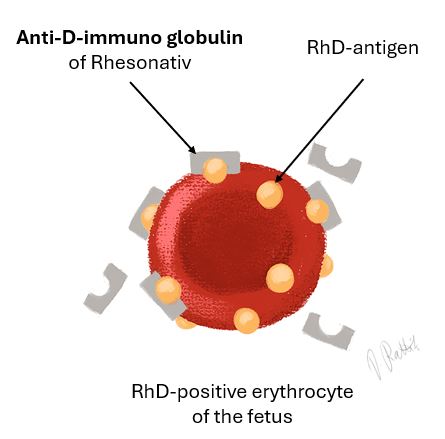
Figure: Rhesonativ's effect on blocking antibodies on the surface of red blood cells
Women who received Rhesonativ 1250 RÜ before the baby was born will receive a second dose of anti-D immunoglobulin within three days of delivery.
Rhesonativ is indicated in RhD-negative women who carry a RhD-positive child, in cases where there is a risk that the mother's and the child's blood may be exposed for some reason, such as pregnancy-related trauma, chorionic biopsy, fetal water exploration, or an external fetal twist. A very small amount of RhD-positive blood is required to achieve immunity; 0.1 ml is sufficient. There is also spontaneous mixing of fetal and maternal blood, mainly after the 28th week (third trimester).
As with any medicine, there may be side effects when Rhesonativ is injected. Pain at the injection site, which can last from a few hours to a few days, is more common. In some cases, mild fever, headache, or rash may occur. Very rarely, a pronounced allergic reaction may occur.
Rhesonativ may be co-administered with other vaccines recommended for pregnant women, such as those against respiratory syncytial virus, influenza, whooping cough, and tick-borne encephalitis.
See: Vaccination during pregnancy